The hotel front desk carries more operational pressure than almost any other part of a property. It sits at the intersection of reservations, housekeeping, billing, guest communication, and room allocation. When everything works smoothly, guests barely notice it.
But the moment operations slow down, the front desk becomes the face of every internal inefficiency: long queues at check-in, rooms that are not ready, billing disputes at departure.
Adding more staff does not always solve the issue. These are not isolated service problems, but coordination problems caused by disconnected systems and the lack of a shared, real-time view of the property. Here are the front-desk bottlenecks that matter most, and how a modern hotel PMS eliminates them.
Bottleneck 1: A Slow Check-In
Hotels today receive bookings from multiple channels — OTAs, direct websites, travel agents, corporate accounts, and walk-ins. Without a unified platform, a typical check-in looks like this: staff pull up the reservation, cross-check it against the OTA booking, confirm the rate, verify whether the room is clean and available, enter payment details, and look for any special requests that may be on a sticky note, in an email, or nowhere at all.
The guest arriving at 8 PM after a delayed flight does not see any of that. They only see the outcome: waiting.
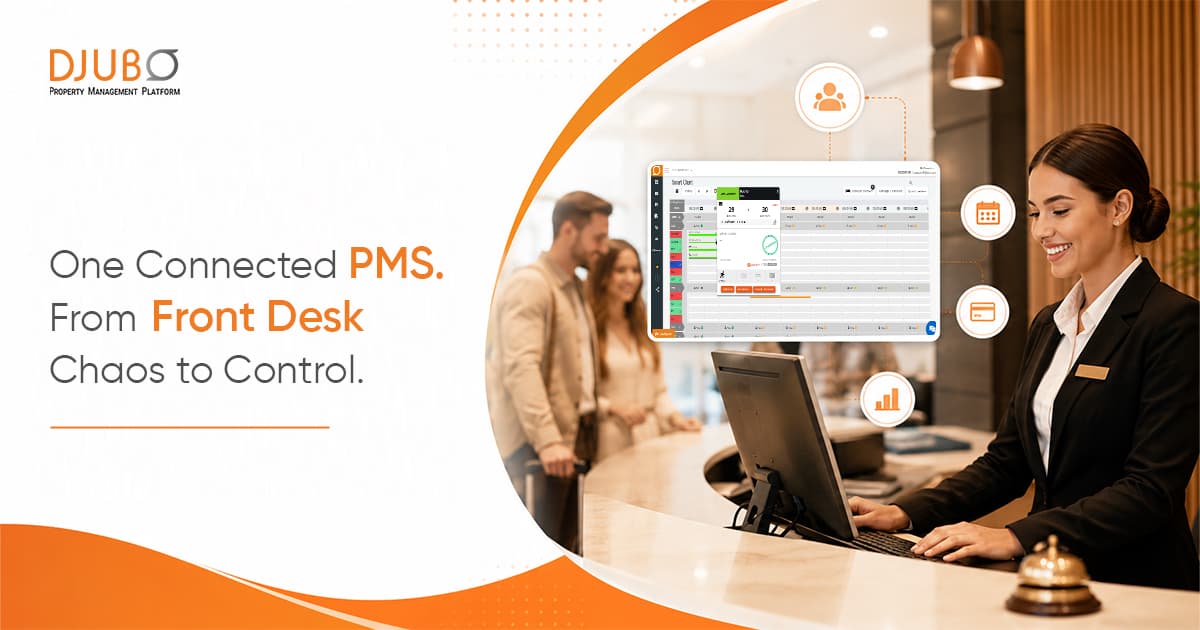
When a guest arrives, front-desk staff should already know which rooms are ready, which bookings are prepaid, which guests have special requests, and which arrivals require priority handling. A connected PMS centralises reservations, room inventory, billing, and guest information into a single operational workflow, reducing dependency on manual coordination between departments. Staff arrive at every check-in conversation fully briefed, not mid-investigation.
Bottleneck 2: The Front Desk and Housekeeping Gap
Room readiness is one of the most common pressure points at the front desk. A guest's patience is tested when they arrive at 3 PM for a 3 PM check-in and are told the room isn't ready. In many cases the room may actually be ready, but housekeeping and reception are working with delayed updates — relying on calls, messages, or paper-based coordination to confirm room status.
Real-time housekeeping integration changes what the front desk can say to a waiting guest. Instead of "we'll check and get back to you," staff can say, "Your room will be ready in about 10 minutes."
When a housekeeper marks a room ready in the system, the front desk sees it immediately. That specificity transforms the guest's experience of waiting from neglect into attentiveness, making the delay far less damaging.
Bottleneck 3: Guest Requests Falling Through the Cracks
Extra towels, airport pickups, late checkouts, maintenance complaints, wake-up calls — front desks handle dozens of guest requests daily, but many hotels still manage them informally through verbal communication or physical notes. The problem is evident: requests get lost, and accountability disappears.
A maintenance complaint may be mentioned at the desk, passed verbally to another team member, and forgotten during a shift change. A late-checkout request may sit in a notebook but never reach housekeeping. From the guest's perspective, the issue is simple: they asked for something, and the hotel did not follow through.
An integrated PMS lets teams record, assign, and monitor guest requests systematically instead of relying on memory. Digital guest profiles are attached to each reservation — preferences, notes, and requests travel with the booking and are visible to every agent on every shift. Guests do not judge hotels by whether issues arise. They judge them by whether requests are reliably acknowledged, tracked, and resolved.
Bottleneck 4: Billing Issues at Checkout
Checkout should be the easiest part of a guest's journey. But when restaurant charges, minibar usage, taxes, discounts, and advance payments are tracked separately and then manually consolidated at departure, billing errors become highly likely — each reconciliation step is a potential point of failure.

Front desk teams should already know what has been paid, what charges have been posted, which discounts apply, and whether the guest folio is ready for review. When POS charges, room billing, and guest folios are connected in a single PMS, most of this work is already done before the guest approaches the desk. The margin for error shrinks, and checkout becomes a confirmation, not a negotiation.
The Real Value of a Connected Front Desk
The real value of a modern PMS is calmer operations, fewer errors, and a more reliable guest experience at scale. Give hotel teams one system that updates in real time, connects departments, and automates repetitive work, and the front desk stops reacting to chaos — staff can focus on guests again.
This also creates room for personalised upsells. Check-in is the highest-value moment for a personalised offer, but most hotels miss it because staff lack context. A PMS that surfaces guest history and real-time availability at check-in turns upselling from a sales tactic into attentive hospitality — a front-desk team who knows a guest is celebrating an anniversary, that this is their third stay, and that a suite is available at a modest upgrade has everything they need for a natural, relevant conversation.
At DJUBO, we build property management systems designed for the real demands of hotel operations. From check-in to checkout, our PMS keeps your team connected, informed, and free to deliver the hospitality your guests came for. Request a demo to see it in action.